Probabilistic Model Zoo
Bayesian Linear Regression
import edward as ed
import inferpy as inf
from inferpy.models import Normal

d, N =  10, 200

# model definition
with inf.ProbModel() as m:

    #define the weights
    w0 = Normal(0,1)
    with inf.replicate(size=d):
        w = Normal(0, 1)

    # define the generative model
    with inf.replicate(size=N):
        x = Normal(0, 1, observed=True, dim=d)
        y = Normal(w0 + inf.matmul(x,w), 1.0, observed=True)

# toy data generation
x_train = Normal(loc=0, scale=1, dim=d).sample(N)
y_train = Normal(loc=5, scale=1, dim=1).sample(N)
data = {x.name: x_train, y.name: y_train}


# compile and fit the model with training data
m.compile()
m.fit(data)

print(m.posterior([w, w0]))
Bayesian Logistic Regression
import edward as ed
import inferpy as inf
from inferpy.models import Normal, Bernoulli, Categorical
import numpy as np

d, N =  10, 500

# model definition
with inf.ProbModel() as m:

    #define the weights
    w0 = Normal(0,1)
    with inf.replicate(size=d):
        w = Normal(0, 1)

    # define the generative model
    with inf.replicate(size=N):
        x = Normal(0, 1, observed=True, dim=d)
        p = w0 + inf.matmul(x, w)
        y = Bernoulli(logits = p, observed=True)


# toy data generation
x_train = Normal(loc=0, scale=1, dim=d).sample(N)
y_train = Bernoulli(probs=[0.4]).sample(N)
data = {x.name: x_train, y.name: np.reshape(y_train, (N,1))}


# compile and fit the model with training data
m.compile()
m.fit(data)

print(m.posterior([w, w0]))
Bayesian Multinomial Logistic Regression
import edward as ed
import inferpy as inf
from inferpy.models import Normal, Bernoulli, Categorical
import numpy as np

d, N =  10, 500

#number of classes
K = 3

# model definition
with inf.ProbModel() as m:

    #define the weights
    w0 = Normal(0,1, dim=K)

    with inf.replicate(size=d):
        w = Normal(0, 1, dim=K)

    # define the generative model
    with inf.replicate(size=N):
        x = Normal(0, 1, observed=True, dim=d)
        p = w0 + inf.matmul(x, w)
        y = Bernoulli(logits = p, observed=True)


# toy data generation
x_train = Normal(loc=0, scale=1, dim=d).sample(N)
y_train = Bernoulli(probs=np.random.rand(K)).sample(N)
data = {x.name: x_train, y.name: np.reshape(y_train, (N,K))}


# compile and fit the model with training data
m.compile()
m.fit(data)

print(m.posterior([w, w0]))
Linear Factor Model (PCA)
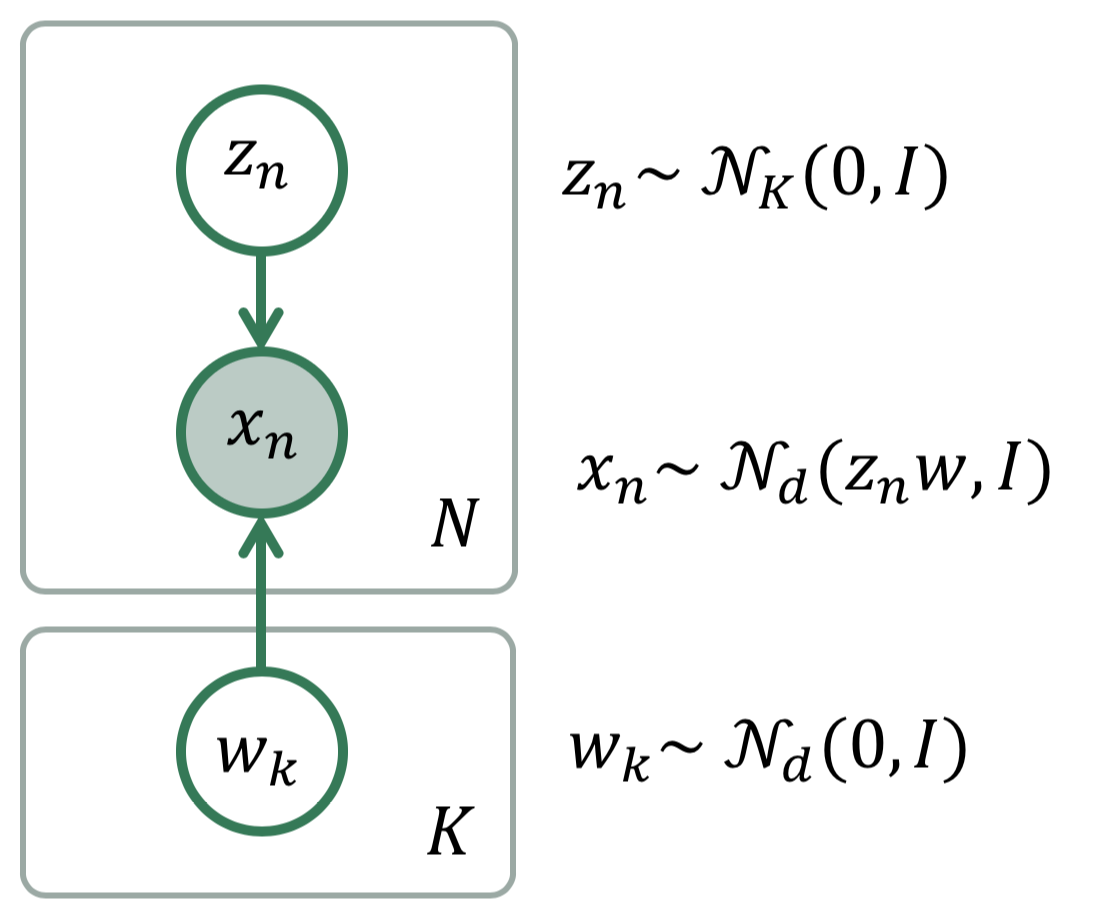
Linear Factor Model
import edward as ed
import inferpy as inf
from inferpy.models import Normal

K, d, N = 5, 10, 200

# model definition
with inf.ProbModel() as m:
    #define the weights
    with inf.replicate(size=K):
        w = Normal(0, 1, dim=d)

    # define the generative model
    with inf.replicate(size=N):
        z = Normal(0, 1, dim=K)
        x = Normal(inf.matmul(z,w),
                   1.0, observed=True, dim=d)

# toy data generation
x_train = Normal(loc=0, scale=1., dim=d).sample(N)
data = {x.name: x_train}


# compile and fit the model with training data
m.compile()
m.fit(data)

#extract the hidden representation from a set of observations
hidden_encoding = m.posterior(z)
PCA with ARD Prior (PCA)
import edward as ed
import inferpy as inf
from inferpy.models import Normal, InverseGamma

K, d, N = 5, 10, 200

# model definition
with inf.ProbModel() as m:
    #define the weights
    with inf.replicate(size=K):
        w = Normal(0, 1, dim=d)

    sigma = InverseGamma(1.0,1.0)

    # define the generative model
    with inf.replicate(size=N):
        z = Normal(0, 1, dim=K)
        x = Normal(inf.matmul(z,w),
                   sigma, observed=True, dim=d)

# toy data generation
x_train = Normal(loc=0, scale=1., dim=d).sample(N)
data = {x.name: x_train}


# compile and fit the model with training data
m.compile()
m.fit(data)

#extract the hidden representation from a set of observations
hidden_encoding = m.posterior(z)
Matrix Factorization
import inferpy as inf
from inferpy.models import Normal

N=200
M=50
K=5

# Shape [M,K]
with inf.replicate(size=K):
    gamma = Normal(0,1, dim=M)

# Shape [N,K]
with inf.replicate(size=N):
    w = Normal(0,1, dim=K)

# x_mn has shape [N,K] x [K,M] = [N,M]

with inf.replicate(size=N):
    x = Normal(inf.matmul(w,gamma), 1, observed = True)

m = inf.ProbModel([w,gamma,x])

data = m.sample(size=N)

log_prob = m.log_prob(data)

m.compile(infMethod = 'KLqp')

m.fit(data)

print(m.posterior([w,gamma]))