Probabilistic Model Zoo
Bayesian Linear Regression
# Shape = [1,d]
w = Normal(0, 1, dim=d)
# Shape = [1,1]
w0 = Normal(0, 1)

with inf.replicate(size = N):
    # Shape = [N,d]
    x = Normal(0,1, dim=d, observed = true)
    # Shape = [1,1] + [N,d]@[d,1] = [1,1] + [N,1] = [N,1] (by broadcasting)
    y = Normal(w0 + tf.matmul(x,w, transpose_b = true ), 1, observed = true)

model = ProbModel(vars = [w0,w,x,y])

data = model.sample(size=N)

log_prob = model.log_prob(sample)

model.compile(infMethod = 'KLqp')

model.fit(data)

print(probmodel.posterior([w0,w]))
Zero Inflated Linear Regression
# Shape = [1,d]
w = Normal(0, 1, dim=d)
# Shape = [1,1]
w0 = Normal(0, 1)

# Shape = [1,1]
p = Beta(1,1)

with inf.replicate(size = N):
    # Shape [N,d]
    x = Normal(0,1000, dim=d, observed = true)
    # Shape [N,1]
    h = Binomial(p)
    # Shape [1,1] + [N,d]@[d,1] = [1,1] + [N,1] = [N,1] (by broadcasting)
    y0 = Normal(w0 + inf.matmul(x,w, transpose_b = true ), 1),
    # Shape [N,1]
    y1 = Delta(0.0)
    # Shape [N,1]*[N,1] + [N,1]*[N,1] = [N,1]
    y = Deterministic(h*y0 + (1-h)*y1, observed = true)

model = ProbModel(vars = [w0,w,p,x,h,y0,y1,y])

data = model.sample(size=N)

log_prob = model.log_prob(sample)

model.compile(infMethod = 'KLqp')

model.fit(data)

print(probmodel.posterior([w0,w]))
Bayesian Logistic Regression
# Shape = [1,d]
w = Normal(0, 1, dim=d)
# Shape = [1,1]
w0 = Normal(0, 1)

with inf.replicate(size = N):
    # Shape = [N,d]
    x = Normal(0,1, dim=d, observed = true)
    # Shape = [1,1] + [N,d]@[d,1] = [1,1] + [N,1] = [N,1] (by broadcasting)
    y = Binomial(logits = w0 + tf.matmul(x,w, transpose_b = true), observed = true)

model = ProbModel(vars = [w0,w,x,y])

data = model.sample(size=N)

log_prob = model.log_prob(sample)

model.compile(infMethod = 'KLqp')

model.fit(data)

print(probmodel.posterior([w0,w]))
Bayesian Multinomial Logistic Regression
# Number of classes
K=10

with inf.replicate(size = K):
    # Shape = [K,d]
    w = Normal(0, 1, dim=d)
    # Shape = [K,1]
    w0 = Normal(0, 1])

with inf.replicate(size = N):
    # Shape = [N,d]
    x = Normal(0,1, dim=d, observed = true)
    # Shape = [1,K] + [N,d]@[d,K] = [1,K] + [N,K] = [N,K] (by broadcasting)
    y = Multinmial(logits = tf.transpose(w0) + tf.matmul(x,w, transpose_b = true), observed = true)

model = ProbModel(vars = [w0,w,x,y])

data = model.sample(size=N)

log_prob = model.log_prob(sample)

model.compile(infMethod = 'KLqp')

model.fit(data)

print(probmodel.posterior([w0,w]))
Mixture of Gaussians
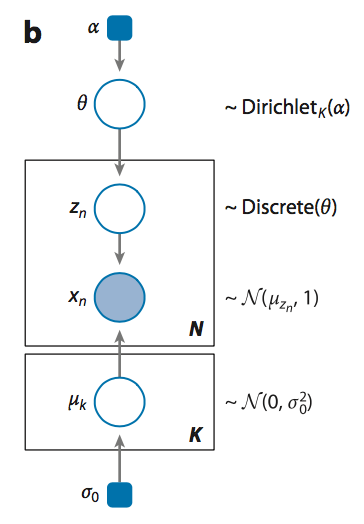
Mixture of Gaussians
Version A
d=3
K=10
N=1000
#Prior
with inf.replicate(size = K):
    #Shape [K,d]
    mu = Normal(loc = 0, scale =1, dim=d)
    #Shape [K,d]
    sigma = InverseGamma(concentration = 1, rate = 1, dim=d)

# Shape [1,K]
p = Dirichlet(np.ones(K))

#Data Model
with inf.replicate(size = N):
    # Shape [N,1]
    z_n = Multinomial(probs = p)
    # Shape [N,d]
    x_n = Normal(loc = tf.gather(mu,z_n), scale = tf.gather(sigma,z_n), observed = true)

model = ProbModel(vars = [p,mu,sigma,z_n, x_n])

data = model.sample(size=N)

log_prob = model.log_prob(sample)

model.compile(infMethod = 'KLqp')

model.fit(data)

print(probmodel.posterior([mu,sigma]))
Version B
d=3
K=10
N=1000
#Prior
mu = Normal(loc = 0, scale =1, shape = [K,d])
sigma = InverseGamma(concentration = 1, rate = 1, shape = [K,d])

# Shape [1,K]
p = Dirichlet(np.ones(K))

#Data Model
z_n = Multinomial(probs = p, shape = [N,1])
# Shape [N,d]
x_n = Normal(loc = tf.gather(mu,z_n), scale = tf.gather(sigma,z_n), observed = true)

probmodel = ProbModel(vars = [p,mu,sigma,z_n, x_n])

data = probmodel.sample(size=N)

log_prob = probmodel.log_prob(sample)

probmodel.compile(infMethod = 'KLqp')

probmodel.fit(data)

print(probmodel.posterior([mu,sigma]))
Linear Factor Model (PCA)
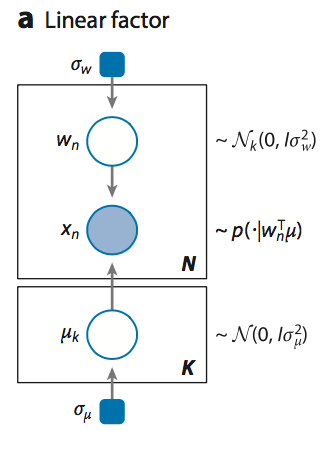
Linear Factor Model
K = 5
d = 10
N=200

with inf.replicate(size = K)
    # Shape [K,d]
    mu = Normal(0,1, dim = d)

# Shape [1,d]
mu0 = Normal(0,1, dim = d)

sigma = 1.0

with inf.replicate(size = N):
    # Shape [N,K]
    w_n = Normal(0,1, dim = K)
    # inf.matmul(w_n,mu) has shape [N,K] x [K,d] = [N,d] by broadcasting mu.
    # Shape [1,d] + [N,d] = [N,d] by broadcasting mu0
    x = Normal(mu0 + inf.matmul(w,mu), sigma, observed = true)

probmodel = ProbModel([mu,mu0,w_n,x])

data = probmodel.sample(size=N)

log_prob = probmodel.log_prob(sample)

probmodel.compile(infMethod = 'KLqp')

probmodel.fit(data)

print(probmodel.posterior([mu,mu0]))
PCA with ARD Prior (PCA)
K = 5
d = 10
N=200

with inf.replicate(size = K)
    # Shape [K,d]
    alpha = InverseGamma(1,1, dim = d)
    # Shape [K,d]
    mu = Normal(0,1, dim = d)

# Shape [1,d]
mu0 = Normal(0,1, dim = d)

# Shape [1,1]
sigma = InverseGamma(1,1, dim = 1)

with inf.replicate(size = N):
    # Shape [N,K]
    w_n = Normal(0,1, dim = K)
    # inf.matmul(w_n,mu) has shape [N,K] x [K,d] = [N,d] by broadcasting mu.
    # Shape [1,d] + [N,d] = [N,d] by broadcasting mu0
    x = Normal(mu0 + inf.matmul(w,mu), sigma, observed = true)

probmodel = ProbModel([alpha,mu,mu0,sigma,w_n,x])

data = probmodel.sample(size=N)

log_prob = probmodel.log_prob(sample)

probmodel.compile(infMethod = 'KLqp')

probmodel.fit(data)

print(probmodel.posterior([alpha,mu,mu0,sigma]))
Mixed Membership Model
Mixed Membership Model
K = 5
d = 10
N=200
M=50

with inf.replicate(size = K)
    #Shape = [K,d]
    mu = Normal(0,1, dim = d)
    #Shape = [K,d]
    sigma = InverseGamma(1,1, dim = d)

with inf.replicate(size = N):
    #Shape = [N,K]
    theta_n = Dirichlet(np.ones(K))
    with inf.replicate(size = M):
        # Shape [N*M,1]
        z_mn = Multinomial(theta_n)
        # Shape [N*M,d]
        x = Normal(tf.gather(mu,z_mn), tf.gather(sigma,z_mn), observed = true)

probmodel = ProbModel([mu,sigma,theta_n,z_mn,x])

data = probmodel.sample(size=N)

log_prob = probmodel.log_prob(sample)

probmodel.compile(infMethod = 'KLqp')

probmodel.fit(data)

print(probmodel.posterior([mu,sigma]))
Latent Dirichlet Allocation
K = 5 # Number of topics
d = 1000 # Size of vocabulary
N=200 # Number of documents in the corpus
M=50 # Number of words in each document

with inf.replicate(size = K)
    #Shape = [K,d]
    dir = Dirichlet(np.ones(d)*0.1)

with inf.replicate(size = N):
    #Shape = [N,K]
    theta_n = Dirichlet(np.ones(K))
    with inf.replicate(size = M):
        # Shape [N*M,1]
        z_mn = Multinomial(theta_n)
        # Shape [N*M,d]
        x = Multinomial(tf.gather(dir,z_mn), tf.gather(dir,z_mn), observed = true)

probmodel = ProbModel([dir,theta_n,z_mn,x])

data = probmodel.sample(size=N)

log_prob = probmodel.log_prob(sample)

probmodel.compile(infMethod = 'KLqp')

probmodel.fit(data)

print(probmodel.posterior(dir))
Matrix Factorization
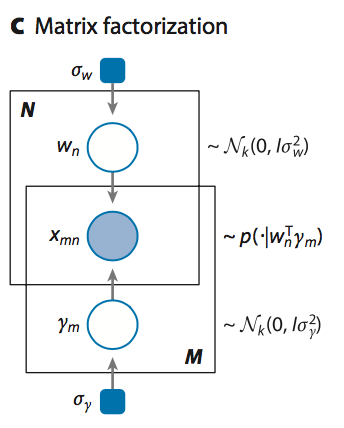
Matrix Factorization Model
Version A
N=200
M=50
K=5

with inf.replicate(name = 'A', size = M)
    # Shape [M,K]
    gamma_m = Normal(0,1, dim = K)

with inf.replicate(name = 'B', size = N):
    # Shape [N,K]
    w_n = Normal(0,1, dim = K)

with inf.replicate(compound = ['A', 'B']):
    # x_mn has shape [N,K] x [K,M] = [N,M]
    x_nm = Normal(tf.matmul(w_n,gamma_m, transpose_b = true), 1, observed = true)


probmodel = ProbModel([w_n,gamma_m,x_nm])

data = probmodel.sample(size=N)

log_prob = probmodel.log_prob(sample)

probmodel.compile(infMethod = 'KLqp')

probmodel.fit(data)

print(probmodel.posterior([w_n,gamma_m]))
Version B
N=200
M=50
K=5

# Shape [M,K]
gamma_m = Normal(0,1, shape = [M,K])

# Shape [N,K]
w_n = Normal(0,1, shape = [N,K])

# x_mn has shape [N,K] x [K,M] = [N,M]
x_nm = Normal(tf.matmul(w_n,gamma_m, transpose_b = true), 1, observed = true)

probmodel = ProbModel([w_n,gamma_m,x_nm])

data = probmodel.sample(size=N)

log_prob = probmodel.log_prob(sample)

probmodel.compile(infMethod = 'KLqp')

probmodel.fit(data)

print(probmodel.posterior([w_n,gamma_m]))
Linear Mixed Effect Model
N = 1000 # number of observations
n_s = 100 # number of students
n_d = 10 # number of instructor
n_dept = 10 # number of departments

eta_s = Normal(0,1, dim = n_s)
eta_d = Normal(0,1, dim = n_d)
eta_dept = Normal(0,1, dim = n_dept)
mu = Normal(0,1)
mu_service = Normal(0,1)

with inf.replicate( size = N):
    student = Multinomial(probs = np.rep(1,n_s)/n_s, observed = true)
    instructor = Multinomial(probs = np.rep(1,n_d)/n_d, observed = true)
    department = Multinomial(probs = np.rep(1,n_dept)/n_dept, observed = true)
    service = Binomial (probs = 0.5, observed = true)
    y = Normal (tf.gather(eta_s,student)
                + bs.gather(eta_d,instructor)
                + bs.gather(eta_dept,department)
                +  mu + mu_service*service, 1, observed = true)

#vars = 'all' automatically add all previously created random variables
probmodel = ProbModel(vars = 'all')

data = probmodel.sample(size=N)

log_prob = probmodel.log_prob(sample)

probmodel.compile(infMethod = 'KLqp')

probmodel.fit(data)

#When no argument is given to posterior, return all non-replicated random varibles
print(probmodel.posterior())
Bayesian Neural Network Classifier
d = 10   # number of features
N = 1000 # number of observations

def neural_network(x):
  h = tf.tanh(tf.matmul(x, W_0) + b_0)
  h = tf.tanh(tf.matmul(h, W_1) + b_1)
  h = tf.matmul(h, W_2) + b_2
  return tf.reshape(h, [-1])

W_0 = Normal(0,1, shape = [d,10])
W_1 = Normal(0,1, shape = [10,10])
W_2 = Normal(0,1, shape = [10,1])

b_0 = Normal(0,1, shape = [1,10])
b_1 = Normal(0,1, shape = [1,10])
b_2 = Normal(0,1, shape = [1,1])


with inf.replicate(size = N):
    x = Normal(0,1, dim = d, observed = true)
    y = Bernoulli(logits=neural_network(x), observed = true)

#vars = 'all' automatically add all previously created random variables
probmodel = ProbModel(vars = 'all')

data = probmodel.sample(size=N)

log_prob = probmodel.log_prob(sample)

probmodel.compile(infMethod = 'KLqp')

probmodel.fit(data)

#When no argument is given to posterior, return all non-replicated random varibles
print(probmodel.posterior())
Variational Autoencoder
from keras.models import Sequential
from keras.layers import Dense, Activation

M = 1000
dim_z = 10
dim_x = 100

#Define the decoder network
input_z  = keras.layers.Input(input_dim = dim_z)
layer = keras.layers.Dense(256, activation = 'relu')(input_z)
output_x = keras.layers.Dense(dim_x)(layer)
decoder_nn = keras.models.Model(inputs = input, outputs = output_x)

#define the generative model
with inf.replicate(size = N)
 z = Normal(0,1, dim = dim_z)
 x = Bernoulli(logits = decoder_nn(z.value()), observed = true)

#define the encoder network
input_x  = keras.layers.Input(input_dim = d_x)
layer = keras.layers.Dense(256, activation = 'relu')(input_x)
output_loc = keras.layers.Dense(dim_z)(layer)
output_scale = keras.layers.Dense(dim_z, activation = 'softplus')(layer)
encoder_loc = keras.models.Model(inputs = input, outputs = output_mu)
encoder_scale = keras.models.Model(inputs = input, outputs = output_scale)

#define the Q distribution
q_z = Normal(loc = encoder_loc(x.value()), scale = encoder_scale(x.value()))

#compile and fit the model with training data
probmodel.compile(infMethod = 'KLqp', Q = {z : q_z})
probmodel.fit(x_train)

#extract the hidden representation from a set of observations
hidden_encoding = probmodel.predict(x_pred, targetvar = z)